Good for Business. Better for the Planet.
We measure our success not just in pallets moved, but in wood diverted from landfills, carbon avoided, and forests protected.
Get a Quote — It's Free
Sustainability Isn't a Marketing Claim — It's How We Operate
The pallet industry generates an enormous amount of waste. Over 500 million pallets circulate in the U.S. supply chain at any given time — and an estimated 35-40 million end up in landfills each year when companies take the path of least resistance. That is an astounding volume of reusable, repurposable wood being buried in the ground.
We believe that path is both economically wasteful and ecologically indefensible. A standard 48x40 GMA pallet contains approximately 33 pounds of lumber — wood that was once a living tree, harvested, milled, dried, and assembled into a product designed to carry thousands of pounds. That pallet can be used 15-20 times in its lifetime. It can be repaired multiple times. And when it finally reaches end of life, the wood can be converted into energy or compost. Throwing that value into a landfill is simply bad stewardship.
So in 2016, we restructured our entire operation around a zero-landfill model. We built a dedicated repair program, signed biomass agreements with regional energy facilities, partnered with composting operations and mushroom farms, and stopped treating damaged pallets as a disposal problem. By 2019, we achieved zero landfill — and we\'ve maintained it for five consecutive years.
Today, 97% of all wood that enters our facility exits as a product (reused or repaired pallets), energy (biomass), or organic matter (compost and agricultural substrate). The remaining 3% consists of contaminated or chemically treated wood that requires specialized disposal — and we\'re working to close even that gap.
Our environmental philosophy is simple: every piece of wood that enters this facility has value. Our job is to find the highest-value use for it — whether that\'s another trip through a supply chain, a board replacement on a repair, heat for a home, or nutrients for a farm. Waste is a failure of imagination, not an inevitability.
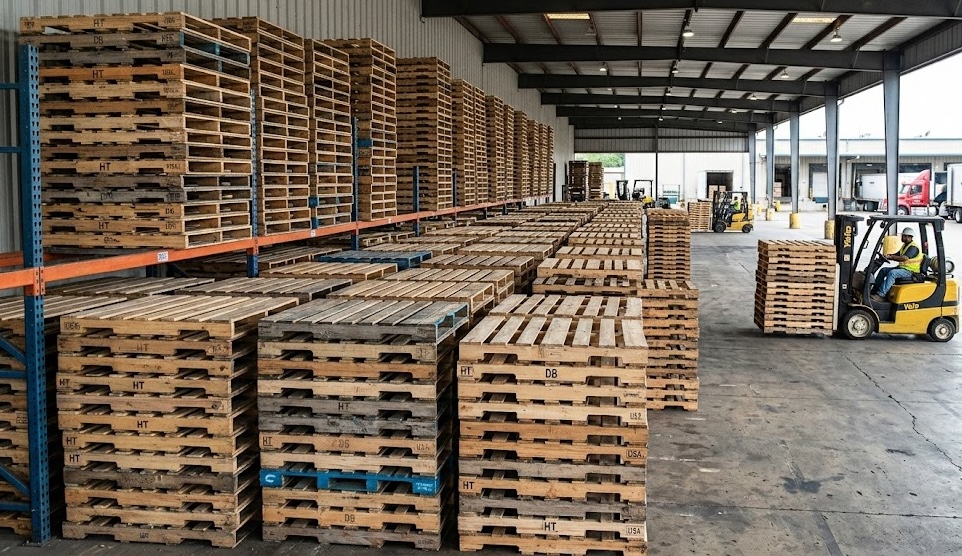
Why used pallets are the sustainable choice:
Reusing one pallet saves ~33 lbs of new lumber from being harvested
No new trees cut, no new energy spent on milling or kiln drying
Used-pallet pricing is 40-60% less than new — sustainability saves money
Same structural performance for 90%+ of warehouse and shipping applications
Carbon already embedded — no new manufacturing emissions generated
Repaired pallets extend wood life by 3-5 additional use cycles
End-of-life wood becomes energy or compost — never landfill waste
Shorter supply chain — locally sourced, not shipped across the country
Our 2024 Environmental Impact
These numbers are real, tracked monthly, and published annually. Accountability isn\'t optional — it\'s baked into our culture.
97%
Landfill Diversion Rate
of all pallets we receive are reused, repaired, or recycled — zero goes to waste
180K+
Pallets Processed / Year
keeping wood in circulation and out of landfills across Connecticut
2,400+
Tons of Wood Diverted
from landfill in 2024 alone through reuse, repair, biomass, and compost
61%
Carbon Reduction
compared to buying all-new pallets for our customers — verified annually
12
Biomass Partners
who convert unusable wood into clean energy for local communities
100%
Heat Treatment Certified
ISPM-15 compliant for all export pallets — no chemical fumigants used
14,200+
Trees Saved Since 2008
by extending the life of used pallets rather than manufacturing new ones
3.8M lbs
CO2 Avoided in 2024
estimated carbon emissions prevented through reuse and repair programs
1.2M+
Pallets Repaired Since 2013
given second, third, and fourth lives through our repair division
850+
Tons to Biomass Energy
of non-repairable wood converted to renewable energy in 2024
320+
Tons to Composting
sawdust and fine wood material diverted to agricultural composting
0
Truckloads to Landfill
since 2019 — five consecutive years of zero landfill waste
From Intake to Impact: Our 8-Step Recycling Process
Every pallet that enters our facility follows a documented process designed to extract maximum value from the wood and ensure nothing goes to waste. Here is exactly how it works.
Collection & Intake
Pallets arrive at our facility via customer drop-off, scheduled pickup, or our satellite collection points in Bridgeport, Stamford, and New Haven. Each incoming load is logged, weighed, and assigned a tracking number. We process an average of 720 pallets per working day.
Customers can schedule pickups online or by phone. We offer regular pickup contracts for high-volume locations. Minimum pickup is 50 pallets; no maximum.
Inspection & Grading
Every pallet is individually inspected and classified into one of four categories: Grade A (reuse as-is), Grade B (reuse with minor cosmetic issues), Repair (structurally sound but needs board or stringer replacement), or Recycle (beyond economical repair). Our grading system follows NWPCA standards with additional internal quality criteria.
Inspectors check deck boards, stringers/blocks, nail condition, dimensional accuracy, and contamination. Grading accuracy exceeds 99% — verified by random QA audits.
Repair & Refurbishment
Pallets classified for repair are moved to our 6,000 sq ft repair bay. Our 14-person repair crew replaces broken deck boards, re-nails loose stringers, resquares warped decks, and re-stamps heat treatment marks where applicable. A repaired pallet costs 60-70% less than a new one and saves 100% of the reusable wood.
Average repair time: 4.2 minutes per pallet. 3,000+ pallets repaired per week. Each repaired pallet undergoes a final QA check before returning to inventory.
Material Recovery & Shredding
Pallets beyond economical repair are disassembled and processed through our industrial shredder. The output is sorted into three streams: clean wood chips (for biomass energy), sawdust and fine material (for composting), and metal fasteners (for scrap recycling). Nothing is wasted.
Our shredder processes up to 8 tons of wood per day. Metal contamination is removed via magnetic separation before chipping. Chip size is calibrated to biomass partner specifications.
Biomass Energy Conversion
Clean wood chips are delivered to our network of 12 biomass energy partners across Connecticut and the tri-state area. These facilities convert the wood into renewable thermal or electrical energy. In 2024, we diverted over 850 tons of wood to biomass — generating enough energy to power approximately 340 homes for a year.
Biomass partners include municipal heating facilities, industrial co-generation plants, and agricultural greenhouses. We maintain supply agreements with each partner to ensure consistent offtake.
Composting & Agricultural Use
Sawdust, fine wood particles, and bark material are delivered to regional composting operations and agricultural users. Local mushroom farms use our sawdust as growing substrate. Composting facilities blend it with food waste and yard trimmings to produce commercial soil amendments.
Over 320 tons of fine wood material diverted to composting in 2024. We work with three composting facilities and two mushroom farms in the region.
Metal Recycling
Nails, staples, and metal fasteners recovered during the disassembly and shredding process are collected, cleaned, and sold to scrap metal recyclers. While the volume is modest compared to wood — approximately 18 tons in 2024 — it represents another waste stream we refuse to send to landfill.
Magnetic separation systems capture 99%+ of metal contamination. Revenue from metal recycling offsets a portion of our processing costs.
Tracking & Annual Reporting
Every step of the process is tracked. We record intake volumes, grading outcomes, repair rates, biomass shipments, compost deliveries, and metal recovery. This data is compiled into our annual sustainability report — published publicly and submitted to the EPA as part of our WasteWise commitment.
Monthly dashboards are reviewed by leadership. Annual reports are published on our website. Data is third-party verified every two years.
Sustainability in Action
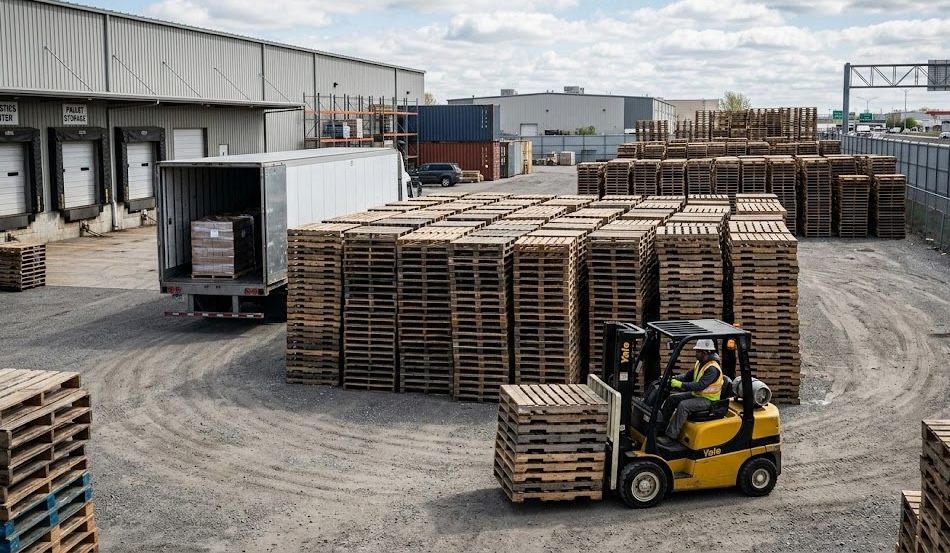
Pallet intake and sorting area — each pallet is graded individually
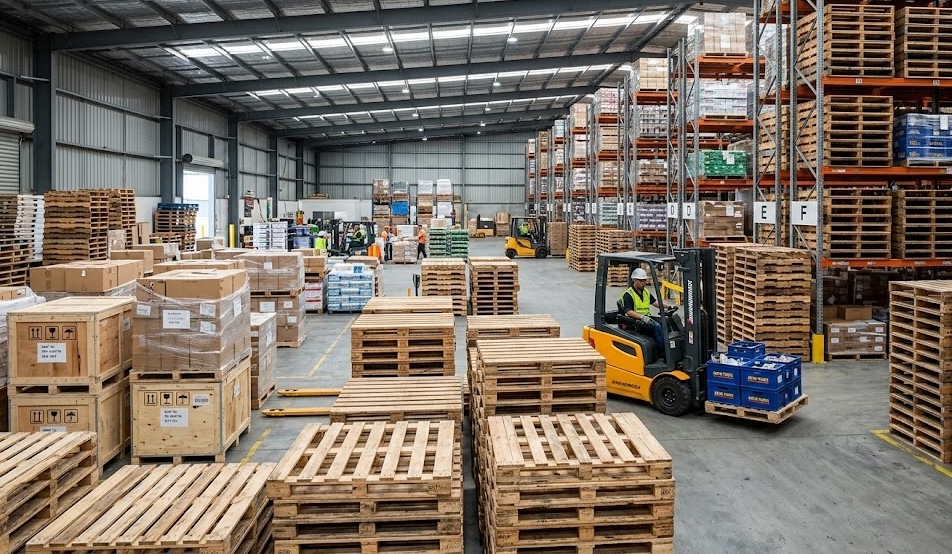
Repair bay operations — 14 technicians, 3,000+ pallets per week
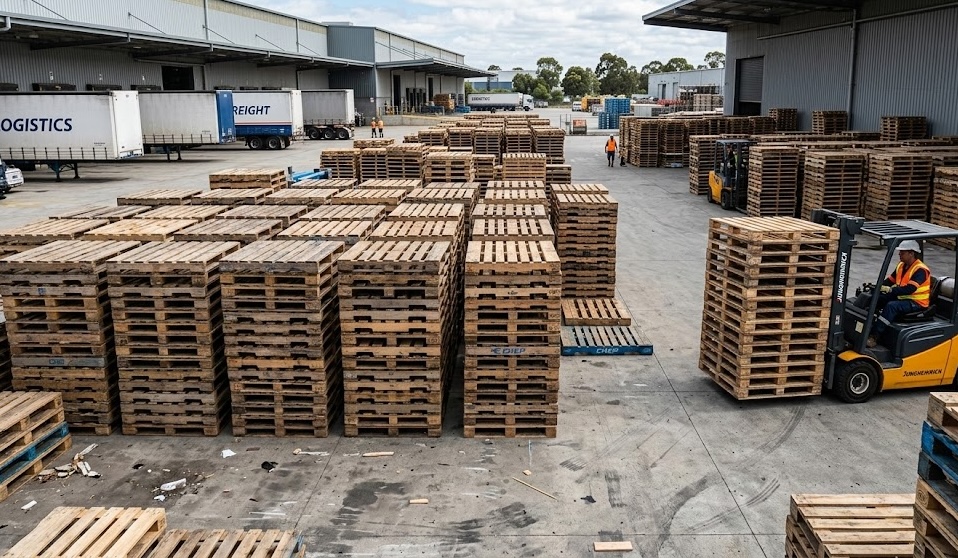
Processed wood chips ready for delivery to biomass energy partners
The Carbon Math: Used vs. New Pallets
Every new pallet manufactured represents embedded carbon — from forest harvesting to sawmill processing to kiln drying to transportation to assembly. Reusing an existing pallet avoids virtually all of that. Here are the numbers.
28.5 lbs
CO2 per New Pallet
A new 48x40 GMA pallet generates approximately 28.5 lbs of CO2 across its lifecycle: tree harvesting (4.2 lbs), sawmill processing (6.8 lbs), kiln drying (8.1 lbs), transportation (5.6 lbs), and assembly (3.8 lbs). Source: Virginia Tech Center for Packaging and Unit Load Design.
3.2 lbs
CO2 per Used Pallet
A reused pallet generates approximately 3.2 lbs of CO2: collection and transportation to our facility (2.1 lbs), inspection and grading (0.4 lbs), and delivery to the customer (0.7 lbs). No harvesting, no milling, no drying, no assembly. The carbon savings are immediate and significant.
88.8%
Carbon Reduction per Pallet
Choosing a used pallet over a new one reduces carbon emissions by 25.3 lbs — an 88.8% reduction per unit. At our 2024 volume of 142,000 reused pallets, that represents approximately 3.59 million lbs (1,629 metric tons) of CO2 avoided. That\'s equivalent to taking 354 cars off the road for a year.
New Pallets vs. Used Pallets: Full Impact Comparison
Side-by-side comparison of the environmental and financial impact of purchasing new versus used pallets for a standard 48x40 GMA pallet.
Metric
New Pallet
Used Pallet
Raw Material
~33 lbs of new lumber from harvested trees
Zero new lumber — existing wood is reused as-is
Carbon Emissions (Manufacturing)
~28.5 lbs CO2 per pallet (logging, milling, transport, assembly)
~3.2 lbs CO2 per pallet (inspection, minor transport)
Water Usage
~18 gallons per pallet (forestry, milling, treatment)
Negligible — no manufacturing water required
Energy Consumption
~12.6 kWh per pallet (sawmill, kiln drying, assembly)
~0.8 kWh per pallet (sorting, inspection, minor handling)
Tree Impact
~0.009 trees per pallet (industry average yield ~110 pallets per tree)
Zero trees — wood already in circulation
Cost to Customer
$12-18 per standard 48x40 GMA pallet
$5-9 per standard 48x40 GMA Grade A/B pallet (40-60% savings)
Landfill Impact
After single use: ~33 lbs of wood to landfill if not recycled
After reuse: returned to cycle, repaired, or processed for energy/compost
Trees Saved: The Forest We Never Had to Cut
Every used pallet that re-enters the supply chain is a pallet that didn\'t need to be manufactured from new lumber. Over 16 years, the cumulative impact is substantial.
1,278
Trees Saved in 2024
Based on 142,000 pallets reused
14,220+
Trees Saved Since 2008
Cumulative impact across 1,580,000+ pallets
47
Acres of Forest Preserved
Equivalent acreage based on average tree density (~300 trees/acre)
~110
Pallets per Tree
Industry average yield — every reused pallet saves ~0.009 trees
How We Calculate Tree Savings
The U.S. pallet industry uses approximately 4.5 billion board feet of lumber annually. A single mature hardwood tree yields roughly 250-300 board feet of usable lumber, which translates to approximately 110 standard 48x40 pallets. When we reuse or repair a pallet instead of manufacturing a new one, the full volume of new lumber that would have been required is avoided.
Our calculation: (Number of pallets reused or repaired) x (0.009 trees per pallet) = trees saved. This is a conservative estimate because it does not account for the additional environmental benefits of avoided milling, drying, transportation, and assembly energy. The real impact is almost certainly higher.
Waste Diversion: Year by Year Since 2016
We began formally tracking diversion metrics in 2016 when we launched our zero-landfill initiative. Here is our progress, year by year.
Year
Wood Diverted
Diversion Rate
2016
1,120 tons
88%
2017
1,340 tons
90%
2018
1,680 tons
92%
2019
1,860 tons
95%
2020
2,020 tons
96%
2021
2,140 tons
96%
2022
2,220 tons
97%
2023
2,340 tons
97%
2024
2,400+ tons
97%
Cumulative Impact by Era
~120,000
pallets processed
~640 tons
wood diverted
~280,000
pallets processed
~1,900 tons
wood diverted
~390,000
pallets processed
~4,200 tons
wood diverted
~460,000
pallets processed
~5,800 tons
wood diverted
~520,000
pallets processed
~7,100 tons
wood diverted
Our Certifications & Compliance
Certifications provide third-party validation that our environmental claims are real. We invest in them because they hold us accountable — and because our customers deserve proof, not promises.
International Plant Protection Convention
Our heat treatment facility is fully certified for international export compliance. All treated pallets carry the official HT stamp — no methyl bromide, no chemical fumigation. We process an average of 15,000 heat-treated pallets annually for export customers in manufacturing, food, and pharmaceutical industries.
Certified since 2016. Annual audits conducted by USDA-approved inspectors. Core temperature monitoring ensures every pallet reaches the required 56C for 30+ minutes.
Sustainable Forestry Initiative
We source new lumber from SFI-certified mills, ensuring responsibly managed forests supply our new pallet production. Chain-of-custody documentation is maintained for every lumber shipment, from forest origin to finished pallet.
All new pallet lumber is traceable to certified forests. We work with four SFI-certified mills in the Northeast to maintain supply diversity and reduce transportation emissions.
Occupational Safety & Health Administration
All warehouse operations meet OSHA General Industry standards. Annual third-party safety audits keep our team and yours protected. Our incident rate is 62% below the industry average for wood product manufacturing.
Monthly safety training. Forklift certification renewed annually. PPE compliance audited weekly. Zero lost-time incidents in 2023 and 2024.
U.S. Environmental Protection Agency
As a WasteWise partner, we commit to waste reduction goals and annual reporting — aligning our internal targets with national sustainability benchmarks. We have exceeded our reduction targets every year since joining the program in 2019.
Annual waste audits submitted to EPA. Recognized as a WasteWise Champion in 2021 for exceeding diversion targets by 340%. Our data contributes to EPA's national recycling metrics.
National Wooden Pallet & Container Association
As a member of the NWPCA, we participate in industry-wide sustainability initiatives, pallet design standards, and best practices for wood recovery and recycling. Membership ensures we stay current with evolving environmental regulations and market standards.
Active participant in the NWPCA Pallet Recycling Committee. Contributor to the annual industry sustainability report. Adherent to PDS (Pallet Design System) standards for all new pallet manufacturing.
Connecticut Department of Energy & Environmental Protection
Registered with CT DEEP for wood waste processing and recycling operations. All of our waste handling, biomass diversion, and composting activities comply with state environmental regulations and permit requirements.
Registered since 2016. Quarterly compliance reports submitted. Storm water management plan in place. No citations or violations since registration.
Our Environmental & Industry Partners
Zero-landfill operations don\'t happen in isolation. Our sustainability model depends on a network of partners who turn what others call waste into energy, compost, and raw materials.
Connecticut Resource Recovery Authority
Biomass & Waste DiversionOur primary partner for large-volume wood chip offtake. CRRA processes our chips into biomass fuel for regional energy facilities. We've worked together since 2017 and deliver approximately 40 tons of material monthly.
New England Wood Pellet
Biomass EnergyClean hardwood chips from our processing line are supplied to New England Wood Pellet for conversion into heating pellets distributed across the Northeast. This partnership began in 2019 and diverts approximately 200 tons annually.
Highfields Composting
Composting & Soil AmendmentFine sawdust and wood particles are delivered to Highfields for blending into commercial compost products. The resulting soil amendments are sold to farms and nurseries across New England.
Fungi Perfecti Northeast
Agricultural SubstrateA regional mushroom farm that uses our hardwood sawdust as growing substrate. We supply approximately 15 tons of clean sawdust monthly — giving agricultural value to material that would otherwise be waste.
Sustainable Forestry Initiative (SFI)
Certified Lumber SourcingAll new lumber we purchase comes from SFI-certified mills. This ensures that even when new pallets are necessary, the wood comes from responsibly managed forests with verified reforestation practices.
EPA WasteWise Program
Federal Environmental PartnershipAs a WasteWise partner, we submit annual waste reduction data to the EPA, set public reduction targets, and participate in national benchmarking. Recognized as a WasteWise Champion in 2021.
Connecticut Green Building Council
Green Operations AdvisoryWe consult with CTGBC on facility energy efficiency improvements, including our upcoming solar panel installation and LED lighting retrofit. Their guidance helped us reduce facility energy consumption by 42%.
Bridgeport Regional Recycling Center
Metal RecoveryAll metal fasteners recovered from pallet disassembly and shredding are delivered to BRRC for processing. Approximately 18 tons of scrap metal recycled annually through this partnership.
How Our Sustainability Helps Your Business
Sustainability isn\'t just good for the planet — it directly benefits your bottom line, your supply chain, and your corporate responsibility goals.
Lower Costs, Same Performance
Used pallets cost 40-60% less than new. Our Grade A and Grade B pallets meet the same structural standards as new pallets for the vast majority of applications. You save money while keeping wood out of landfills.
Documented Environmental Impact
We provide annual sustainability certificates to volume customers documenting the number of pallets reused, tons of wood diverted, and estimated CO2 avoided. Use these for your own ESG reporting and sustainability disclosures.
Buyback & Removal Services
Don't throw away your surplus or damaged pallets. We'll pick them up, pay you fair market value for reusable ones, and responsibly process the rest. You clear your dock, get paid, and keep pallets out of landfills.
Supply Chain Resilience
During lumber shortages and supply chain disruptions, our deep used-pallet inventory keeps your operations running when new pallets are scarce or overpriced. In 2021, we saved customers an estimated $2.1M vs. new-pallet pricing.
Regulatory Compliance Support
All pallets are graded to NWPCA standards. Export pallets are ISPM-15 heat-treated and stamped. Food and pharma customers receive pallets that meet FDA and industry sanitation requirements.
Carbon Offset Documentation
For every order of used or repaired pallets, we can provide estimated carbon savings compared to purchasing new. This documentation supports corporate sustainability goals and green procurement policies.
See the Difference
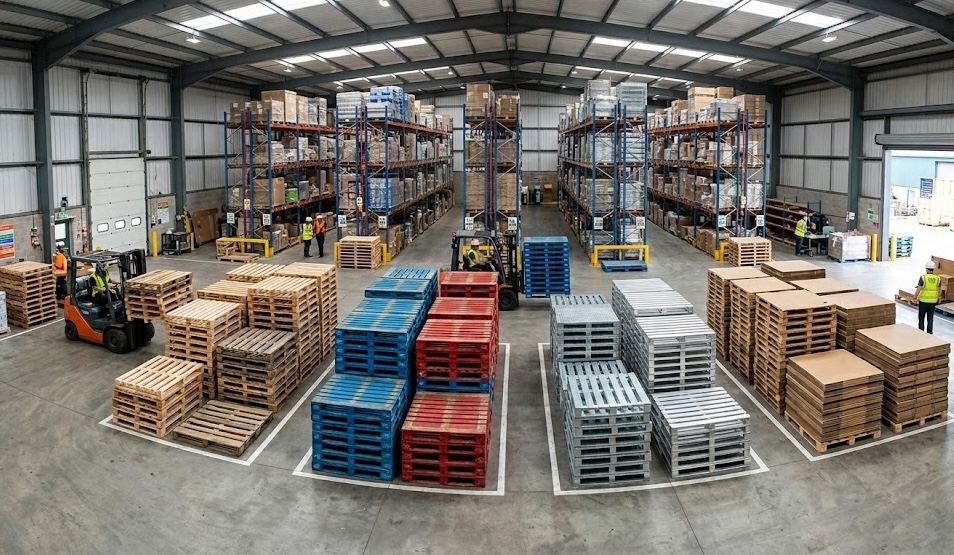
Repair Over Replace
Our repair division processes over 3,000 pallets per week — each one saving 33 lbs of new lumber and 28.5 lbs of CO2. A repaired pallet can serve 3-5 additional use cycles before it reaches end of life. That\'s years of additional value extracted from wood that would otherwise be discarded.
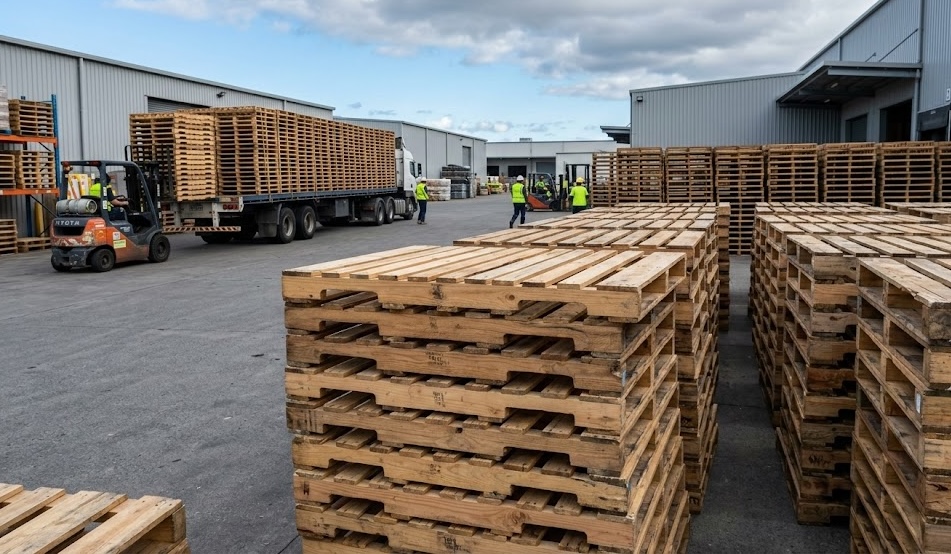
Nothing Goes to Waste
When a pallet can\'t be repaired, it\'s broken down and processed. Clean wood chips go to biomass energy facilities. Sawdust goes to mushroom farms and composting operations. Metal fasteners are recycled. Even the bark is composted. Our zero-landfill commitment means finding a purpose for every piece of material.
Sustainability Roadmap: 2025-2030
We set public targets and report on them annually. Accountability means nothing if the goals live only in an internal spreadsheet. Here is where we\'re headed.
Install 120kW rooftop solar array — targeting 35% of facility electricity from solar
Achieve 98% landfill diversion rate — up from 97%
Launch pallet lifecycle tracking system with QR codes for customer visibility
Convert 50% of delivery fleet (4 trucks) to hybrid or electric for routes under 150 miles
Expand biomass partnerships to 16 regional facilities
Reduce per-pallet water consumption in heat treatment by 20% through recirculation system
Establish pallet-leasing program to reduce single-use pallet demand by 20%
Publish full Scope 1, 2, and 3 carbon inventory report — third-party verified
Achieve 99% landfill diversion rate
Complete fleet electrification for all routes under 200 miles
Install rainwater harvesting system for facility washing and dust suppression
Achieve carbon-neutral operations across all Scope 1 and Scope 2 emissions
Our 2030 Goal
Carbon-Neutral Operations
By 2030, we aim to achieve carbon neutrality across all Scope 1 and Scope 2 emissions — through a combination of solar energy, fleet electrification, process efficiency, and verified carbon offsets for any remaining emissions.
“We don\'t recycle pallets because it\'s trendy. We do it because throwing away reusable wood is wasteful, and waste is something we refuse to accept. Every pallet we save from a landfill is proof that doing the right thing and running a profitable business are not in conflict.”
— Thomas Jacobs, Sustainability Director, Norwalk Pallets
Make Your Supply Chain Greener
Every pallet you buy used or repaired instead of new saves wood, saves carbon, and saves money. Ready to make the switch?